


|
« Back ⇧List⇧ Next » |

In my thoughts about the scoring of the textual source, the first aim was to choose a musical language that today would perhaps be called Orff 2.0; it should sound like a composition by Carl Orff in the 21st century, without however neglecting the distinct individual character for each composer.
The textual basis of the Wessobrunner Prayer in Middle High German language seemed to be the most suitable for this project.
Formally shows prayer on a clear tripartite structure, which takes place in my composition consistently. In addition, the text reports consistently of things that have already been available in the "master plan" of the Creator, but not yet created. I illustrate it as Creation-priori and take it in addition to the structure formal presentation as a basis for my compositional deliberations.
Firstly, an unspecified named lyrical ego reports of the "greatest miracles". What follows is a list of the things that the Almighty has planned, but still it is stuck in chaos, not yet existing. An exciting synthesis and compositional task, I find: the musical representation of something that the Creator has already planned out from the chaos and already exists in the story, but not for humans, was visualized. It is almost equal to a genome, which already includes a plan for the finished creatures without betraying what might once come of it.
Finally, the mention of the Creator, the Almighty God follows, who was together with the plan for creation from the beginning because again through the lyrical ego.
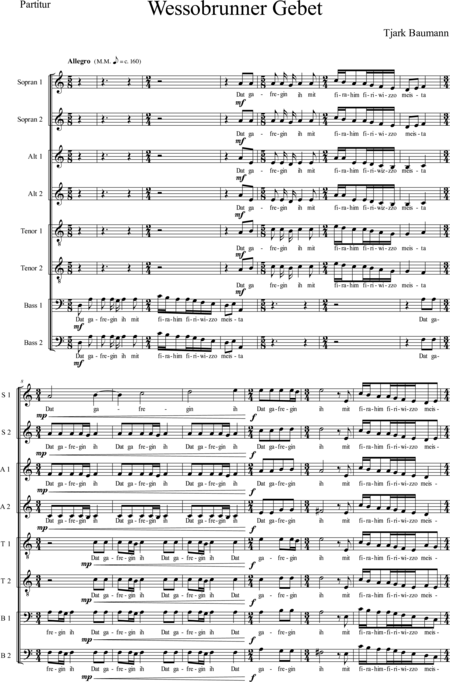
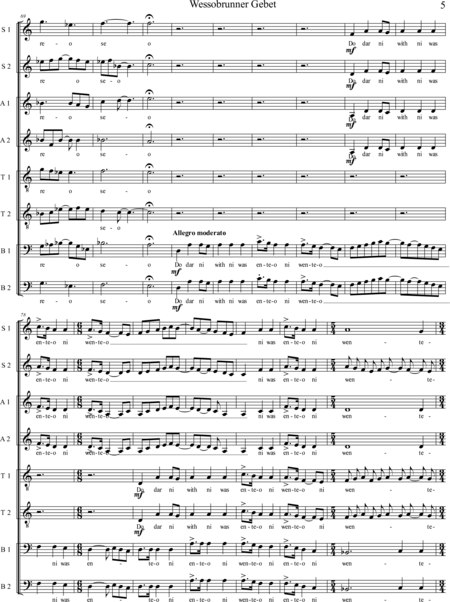
The tripartite occurring in the textual basis grossly formally has been captured in the composition. The first part (one to twenty-one) is determined by a highly oriented Orff, rhythmically declaimed alternately in the registers, tonal language, chord juxtapositions, homophony. Also in this internal structure, the mystical number is three predominantly (e.g. showing parts eight three levels, there are three cues to the culmination in measure eleven, the first part will be decided by three final calls in the men's parts. The lyrical ego thus shows to some extent a musical proximity to Orff.
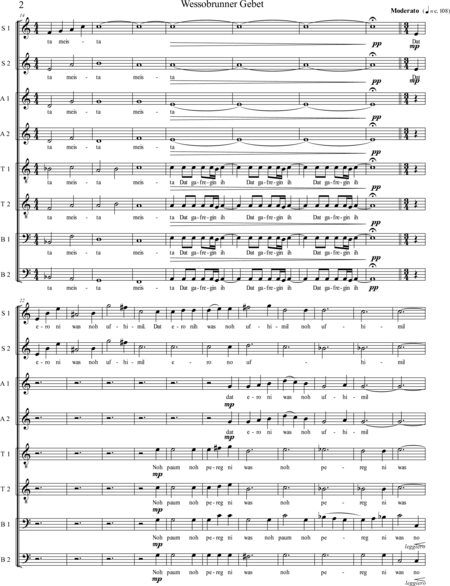
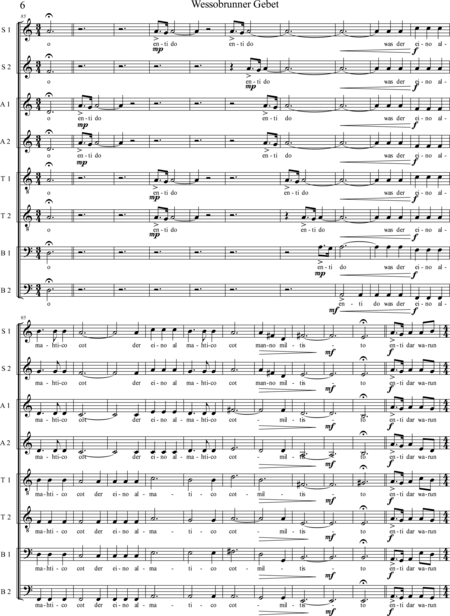
The second part (twenty-two to seventy-one) is determined by seeking an "unfinished' melody", harmony and cadences. It also again shows a tripartite. At the beginning women's voices maintain the search for Earth and Sky, a compositional style of the motet "Why is the light given" by J. Brahms.
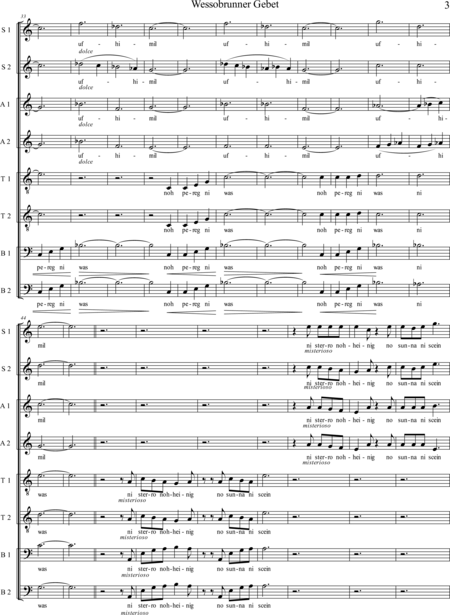
The men's parts at the same time report on the absence of mountain and tree, earthly things. However, the creation-priori appears however in the final chord, the almost pure C major (without root in the bass and non-alienated). It is to some extent an outlook, as it will be again. The second section of the middle part is torn: no stars that provide orientation, no sun gives life. Consequently, this part also ends in a harmonious slightly enriched tonal agglomeration, which is intended to symbolize the prevailing chaos.
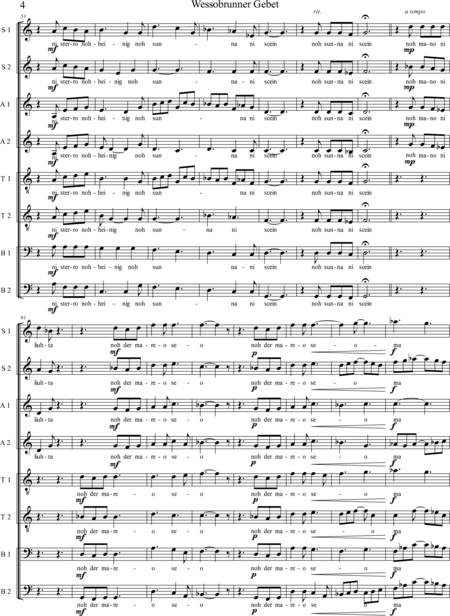
Quite differently, the last part of the (textual) midsection (seventy-two to one hundred twenty-two). The infinite sea rushes to chaos clearly audible in the infinite sequence of the tides.
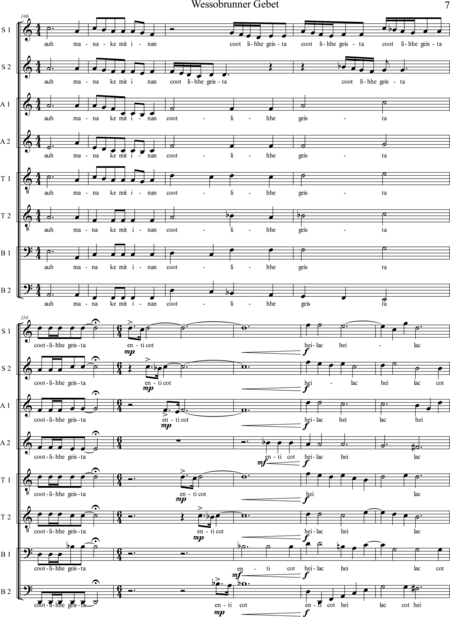
Last but not least taking the third part of the outer structure distinct correlation with part one, both lyrically and compositionally. The declamatory ascending with Quinn (D-A), melodic line, rhythm, all reminiscent of the lyrical ego of the first part, for me again a reverential nod to Carl Orff. The presence of the Creator in the great cosmos, of an omnipotent God illuminate the quick succession in pending objections from in part eighty-six, et seq. or one hundred ten, et seq.
The sonorous, strong and columnar chords in part ninety-four are certainly borrowed from the model composition of C. Orff ... an event!
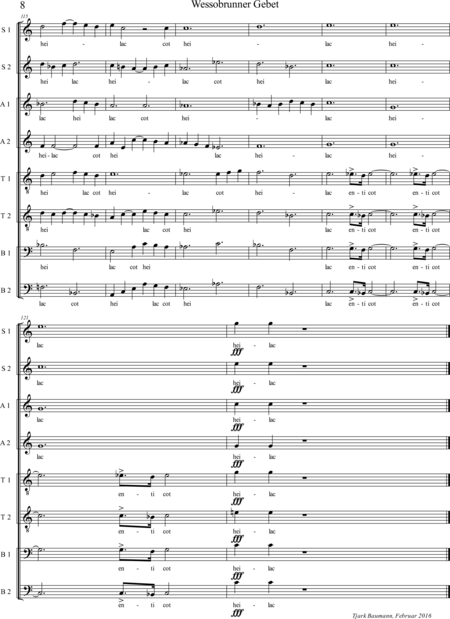
The number of ghosts flying past from part one hundred eight in the soprano sections responsively and find their final destination in measure one hundred ten in a chord, of the beat, but also to express beauty and something mysterious. The final part is dedicated to the textual appearance of the Saviour. The women's parts in turn reach the radiant and creative complete C major in measure one hundred nineteen, however, the male parts show the intrinsically further the imperfect minor.
Thus, C major sounds like creation and C minor as the imperfect chaos simultaneously! Nevertheless, the outlook, the anticipation, the deliberative element here, should stay on the perfect creation, insofar logically follows a strong common conclusion in the completed C major to the “Saviour”.
Scroll to preview or Click to open
The textual basis of the Wessobrunner Prayer in Middle High German language seemed to be the most suitable for this project.
Formally shows prayer on a clear tripartite structure, which takes place in my composition consistently. In addition, the text reports consistently of things that have already been available in the "master plan" of the Creator, but not yet created. I illustrate it as Creation-priori and take it in addition to the structure formal presentation as a basis for my compositional deliberations.
Firstly, an unspecified named lyrical ego reports of the "greatest miracles". What follows is a list of the things that the Almighty has planned, but still it is stuck in chaos, not yet existing. An exciting synthesis and compositional task, I find: the musical representation of something that the Creator has already planned out from the chaos and already exists in the story, but not for humans, was visualized. It is almost equal to a genome, which already includes a plan for the finished creatures without betraying what might once come of it.
Finally, the mention of the Creator, the Almighty God follows, who was together with the plan for creation from the beginning because again through the lyrical ego.
The tripartite occurring in the textual basis grossly formally has been captured in the composition. The first part (one to twenty-one) is determined by a highly oriented Orff, rhythmically declaimed alternately in the registers, tonal language, chord juxtapositions, homophony. Also in this internal structure, the mystical number is three predominantly (e.g. showing parts eight three levels, there are three cues to the culmination in measure eleven, the first part will be decided by three final calls in the men's parts. The lyrical ego thus shows to some extent a musical proximity to Orff.
The second part (twenty-two to seventy-one) is determined by seeking an "unfinished' melody", harmony and cadences. It also again shows a tripartite. At the beginning women's voices maintain the search for Earth and Sky, a compositional style of the motet "Why is the light given" by J. Brahms.
The men's parts at the same time report on the absence of mountain and tree, earthly things. However, the creation-priori appears however in the final chord, the almost pure C major (without root in the bass and non-alienated). It is to some extent an outlook, as it will be again. The second section of the middle part is torn: no stars that provide orientation, no sun gives life. Consequently, this part also ends in a harmonious slightly enriched tonal agglomeration, which is intended to symbolize the prevailing chaos.
Quite differently, the last part of the (textual) midsection (seventy-two to one hundred twenty-two). The infinite sea rushes to chaos clearly audible in the infinite sequence of the tides.
Last but not least taking the third part of the outer structure distinct correlation with part one, both lyrically and compositionally. The declamatory ascending with Quinn (D-A), melodic line, rhythm, all reminiscent of the lyrical ego of the first part, for me again a reverential nod to Carl Orff. The presence of the Creator in the great cosmos, of an omnipotent God illuminate the quick succession in pending objections from in part eighty-six, et seq. or one hundred ten, et seq.
The sonorous, strong and columnar chords in part ninety-four are certainly borrowed from the model composition of C. Orff ... an event!
The number of ghosts flying past from part one hundred eight in the soprano sections responsively and find their final destination in measure one hundred ten in a chord, of the beat, but also to express beauty and something mysterious. The final part is dedicated to the textual appearance of the Saviour. The women's parts in turn reach the radiant and creative complete C major in measure one hundred nineteen, however, the male parts show the intrinsically further the imperfect minor.
Thus, C major sounds like creation and C minor as the imperfect chaos simultaneously! Nevertheless, the outlook, the anticipation, the deliberative element here, should stay on the perfect creation, insofar logically follows a strong common conclusion in the completed C major to the “Saviour”.
Recommended:
Perhaps appropriate:
 download
Free notes
|




| Performance: | NOT subject to notification (ASCAP, BMI, GEMA etc.) |
| orchestration: |
Mixed choir a cappella
Choir>SSAATTBB
|
| Language in song: | Latin |
| Quantity of pages: | 8 |
| Visit: | 9507 |
Preparation for next contest