


|
« Back ⇧List⇧ Next » |

This piece is based on a fragment of Rainer Maria Rilke's Orpheus. Eurydice. Hermes. This fragment is almost entirely dedicated to the transformation of Eurydice during his stay in the underworld. Her new nature let her apart from the reality of the living; be without being.
A perpetual ascending harmonic process, serves as a unifying skeleton of the musical whole, and a rhetorical representation of Anabasis in which the characters find themselves. The perpetual ascending harmony is only suspended a few times; small ellipses were necessary to punctuate elements of the text, and provide with rhythm the general musical structure.
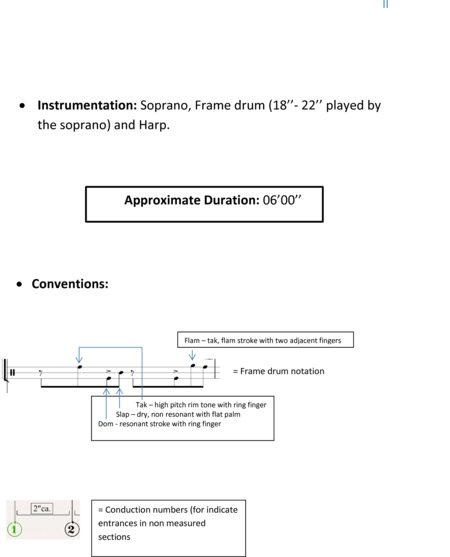
The piece begins with a prelude that represents Orpheus in the underworld, prisoner of an immense anxiety, in his slow and painful ascent. Full of doubt. Then, an ostinato on frame drum and harp serves as introduction for the text "She was no longer the beautiful blonde woman ..." in which the aspects with which Eurydice could be identified among the living are denied. The emotional context of the underworld is maintained in this section; dark and painful.
The next section, on the other hand, deals with the new nature of Eurydice, who "Now walked loose like long hair". The perpetual ascending harmony is here enlarged; expanded. Leaving the characters to continue their ascent slowly, while singing to the new spiritual nature of Eurydice, who like a gas or a liquid, lacks definite form and self-containment.
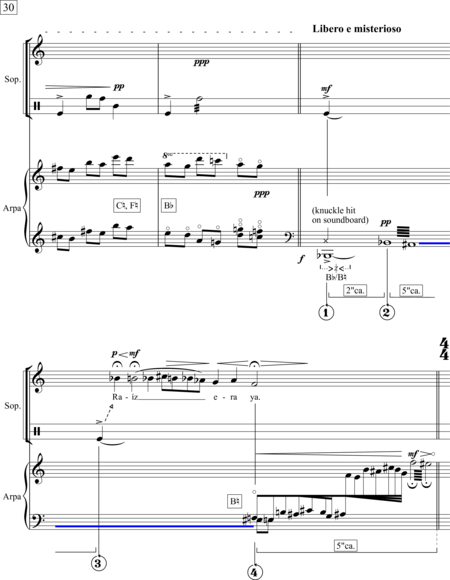
The text "She was already Root", Appears in the work beneath a temporary suspension of movement. This statism, it's a contrasting element with all the previous music, and helps to give this line an emphasis similar to the one that Rilke gives in the poem leaving this sentence alone, like an island. The importance of this text lies in that it defines the nature of the transfixed Eurydice.
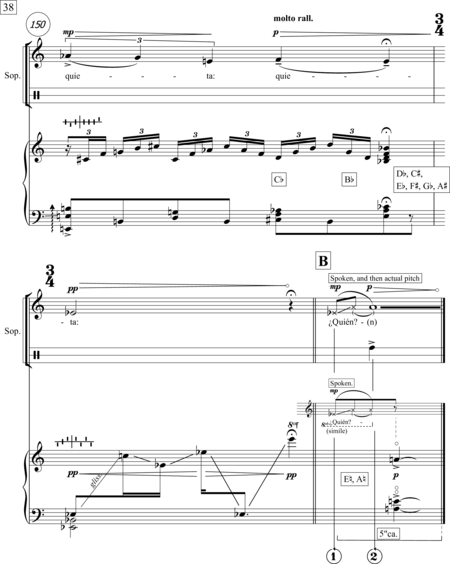
After retaking the upward movement of the music progressively, the absence of present awareness of Eurydice is demonstrated when Hermes stops her to say that Orpheus has turned around, and she simply asks "who?”. These two voices, the God's one and Eurydice's, are treated with a spoken-singing effect, in unison between the soprano and harpist, in order to emphasize the characters words.
Scroll to preview or Click to open
A perpetual ascending harmonic process, serves as a unifying skeleton of the musical whole, and a rhetorical representation of Anabasis in which the characters find themselves. The perpetual ascending harmony is only suspended a few times; small ellipses were necessary to punctuate elements of the text, and provide with rhythm the general musical structure.
The piece begins with a prelude that represents Orpheus in the underworld, prisoner of an immense anxiety, in his slow and painful ascent. Full of doubt. Then, an ostinato on frame drum and harp serves as introduction for the text "She was no longer the beautiful blonde woman ..." in which the aspects with which Eurydice could be identified among the living are denied. The emotional context of the underworld is maintained in this section; dark and painful.
The next section, on the other hand, deals with the new nature of Eurydice, who "Now walked loose like long hair". The perpetual ascending harmony is here enlarged; expanded. Leaving the characters to continue their ascent slowly, while singing to the new spiritual nature of Eurydice, who like a gas or a liquid, lacks definite form and self-containment.
The text "She was already Root", Appears in the work beneath a temporary suspension of movement. This statism, it's a contrasting element with all the previous music, and helps to give this line an emphasis similar to the one that Rilke gives in the poem leaving this sentence alone, like an island. The importance of this text lies in that it defines the nature of the transfixed Eurydice.
After retaking the upward movement of the music progressively, the absence of present awareness of Eurydice is demonstrated when Hermes stops her to say that Orpheus has turned around, and she simply asks "who?”. These two voices, the God's one and Eurydice's, are treated with a spoken-singing effect, in unison between the soprano and harpist, in order to emphasize the characters words.








































Recommended:
Perhaps appropriate:
 download
Free notes
|




| Performance: | NOT subject to notification (ASCAP, BMI, GEMA etc.) |
| orchestration: |
Voice solo with (chamber) orchestra
Solo>sop+Perc+Hp
|
| Language in song: | Spanish |
| Quantity of pages: | 43 |
| Visit: | 6249 |
Preparation for next contest