


|
« Atrás ⇧Lista⇧ Continuar » |

Work Description:
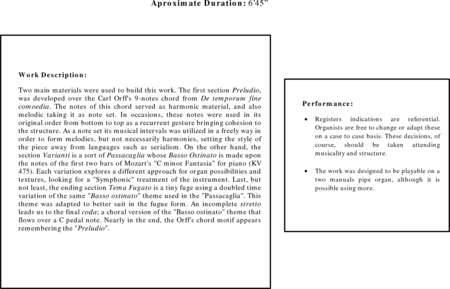
Two main materials were used to build this work. The first section Preludio, was developed over the Carl Orff's 9-notes chord from De temporum fine comoedia. The notes of this chord served as harmonic material, and also melodic taking it as note set. In occasions, these notes were used in its original order from bottom to top as a recurrent gesture bringing cohesion to the structure. As a note set its musical intervals was utilized in a freely way in order to form melodies, but not necessarily harmonies, setting the style of the piece away from languages such as serialism. On the other hand, the section Varianti is a sort of Passacaglia whose Basso Ostinato is made upon the notes of the first two bars of Mozart's "C minor Fantasia" for piano (KV 475). Each variation explores a different approach for organ possibilities and textures, looking for a "Symphonic" treatment of the instrument. Last, but not least, the ending section Tema Fugato is a tiny fuge using a doubled time variation of the same "Basso ostinato" theme used in the "Passacaglia". This theme was adapted to better suit in the fugue form. An incomplete stretto leads us to the final coda; a choral version of the "Basso ostinato" theme that flows over a C pedal note. Nearly in the end, the Orff's chord motif appears remembering the "Preludio".
Deslice para vista previa o hacer click para abrir
Two main materials were used to build this work. The first section Preludio, was developed over the Carl Orff's 9-notes chord from De temporum fine comoedia. The notes of this chord served as harmonic material, and also melodic taking it as note set. In occasions, these notes were used in its original order from bottom to top as a recurrent gesture bringing cohesion to the structure. As a note set its musical intervals was utilized in a freely way in order to form melodies, but not necessarily harmonies, setting the style of the piece away from languages such as serialism. On the other hand, the section Varianti is a sort of Passacaglia whose Basso Ostinato is made upon the notes of the first two bars of Mozart's "C minor Fantasia" for piano (KV 475). Each variation explores a different approach for organ possibilities and textures, looking for a "Symphonic" treatment of the instrument. Last, but not least, the ending section Tema Fugato is a tiny fuge using a doubled time variation of the same "Basso ostinato" theme used in the "Passacaglia". This theme was adapted to better suit in the fugue form. An incomplete stretto leads us to the final coda; a choral version of the "Basso ostinato" theme that flows over a C pedal note. Nearly in the end, the Orff's chord motif appears remembering the "Preludio".















Recomendado:
 Quizás sea apropiado:
Añadido por: gerhard
Añadido en fecha: 16.08.2019
 Descargar
Descarga de partituras gratis
|




| Interpretación: | La ejecución de la obra es libre (GEMA, SUISA, AKM etc.) |
| Instrumentación: | |
| Número de páginas: | 16 |
| Visitas: | 5750 |
Preparación para el próximo concurso