


|
« Atrás ⇧Lista⇧ Continuar » |

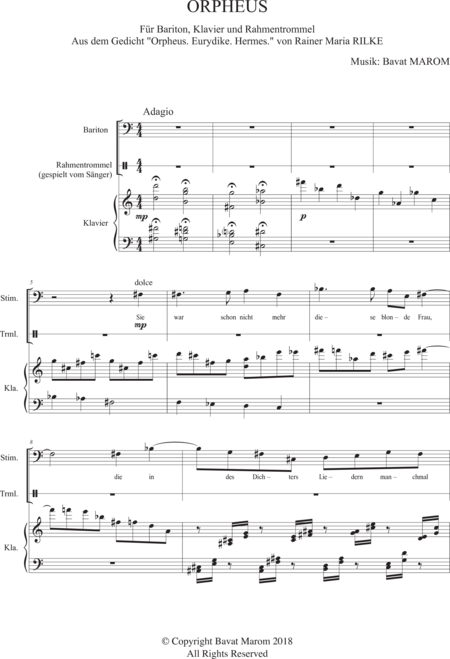
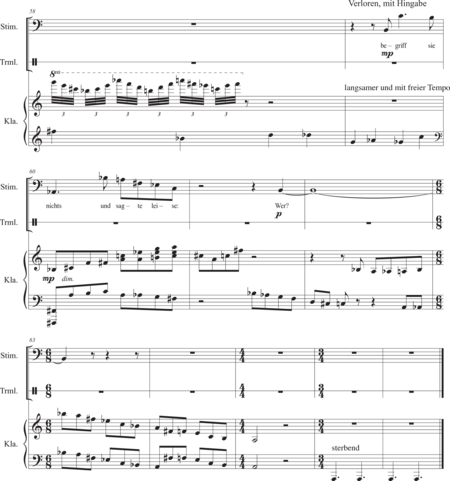
Composing the music to the wonderful words with which Rilke painted the sad and mysterious story of Orpheus and Eurydike, I tried to underline and support Rilke's attempt to explain Orpheus's psychological journey up to the point of turning around and losing everything.
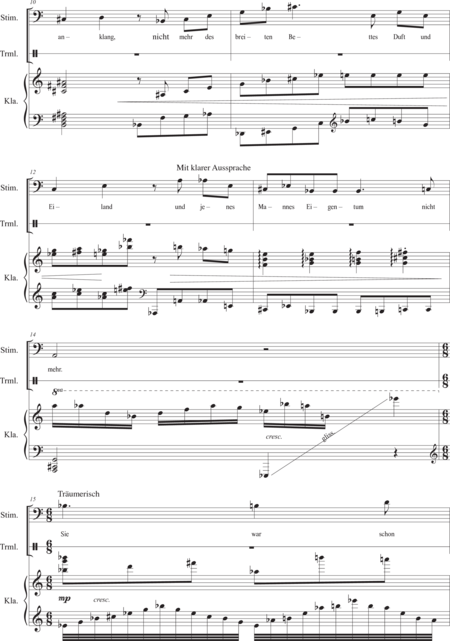
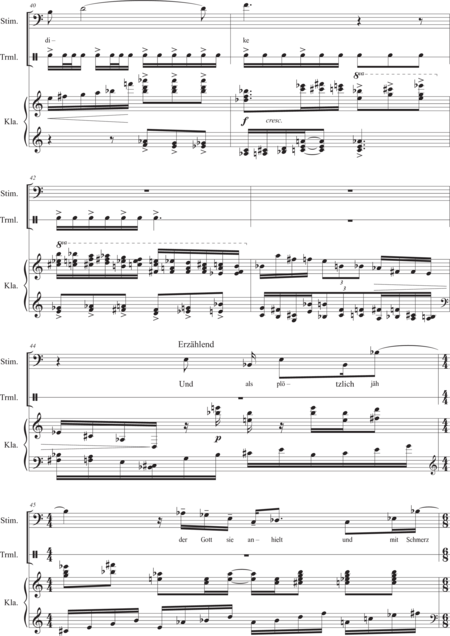
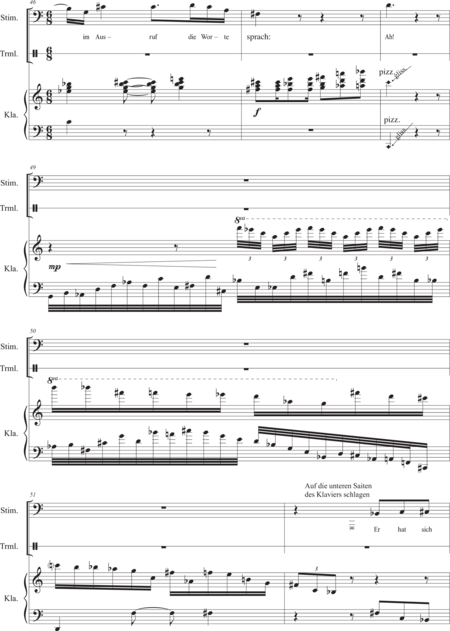
In this section of the poem, there are 3 voices: The narrator, Orpheus and Eurydike, whereas, we do not actually get to hear any text out of Orpheus's mouth, and the only word that we hear from Eurydike, quoted by the narrator, is "Who?" but the drama revolves around this unspoken, extremely tense dialogue between the two lovers. An unspoken dialogue that takes place in Orpheus's mind during his journey from the bottom of the underworld all the way up to the world of the living. There are two layers to his reality: One is the external reality, in which Orpheus is places at the bottom of the underworld, making his way uphill to the world of the living. In my composition I intended to voice his footsteps going up the hill, the wind blowing against his flaring coat, his heavy breath sounds, and the the wind that plays on the lyre which he holds underneath his arm. The other reality of this picture, is the inner state of being of the two characters: Orpheus embodies the energy of life, of passion. Rilke refers to him in the poem as "Gott des ganges und der weiten Botschaft" (God of the walking and the distant message) he brings the message of love and life to the world of eternal dead. With his life force he could defy death, if he would only be strong enough to realize that she is in a state of a cocoon, and trust his strength to turn her yet again into a butterfly. If he could only keep his faith in life and love and not look back. In his memory she is still his wife, his lover, full of love and life, but Rilke brings forth the argument that she is now in a different state of being, "Sie war schon Wurzel" (she already turned into a root). This, according to Rilke is the reason why the passionate Orpheus could not hold himself from looking back at her, from asking for her response, asking for a proof that she follows him along on this long climb, that she is still herself, still loves him. He needed so badly to feel her life force, and could not take the new reality that she was in. He could not take her silence. Her silence breaks his bravery. This inner conflict between his essence of life and her essence of death is what I tried to voice in my composition.
Deslice para vista previa o hacer click para abrir
In this section of the poem, there are 3 voices: The narrator, Orpheus and Eurydike, whereas, we do not actually get to hear any text out of Orpheus's mouth, and the only word that we hear from Eurydike, quoted by the narrator, is "Who?" but the drama revolves around this unspoken, extremely tense dialogue between the two lovers. An unspoken dialogue that takes place in Orpheus's mind during his journey from the bottom of the underworld all the way up to the world of the living. There are two layers to his reality: One is the external reality, in which Orpheus is places at the bottom of the underworld, making his way uphill to the world of the living. In my composition I intended to voice his footsteps going up the hill, the wind blowing against his flaring coat, his heavy breath sounds, and the the wind that plays on the lyre which he holds underneath his arm. The other reality of this picture, is the inner state of being of the two characters: Orpheus embodies the energy of life, of passion. Rilke refers to him in the poem as "Gott des ganges und der weiten Botschaft" (God of the walking and the distant message) he brings the message of love and life to the world of eternal dead. With his life force he could defy death, if he would only be strong enough to realize that she is in a state of a cocoon, and trust his strength to turn her yet again into a butterfly. If he could only keep his faith in life and love and not look back. In his memory she is still his wife, his lover, full of love and life, but Rilke brings forth the argument that she is now in a different state of being, "Sie war schon Wurzel" (she already turned into a root). This, according to Rilke is the reason why the passionate Orpheus could not hold himself from looking back at her, from asking for her response, asking for a proof that she follows him along on this long climb, that she is still herself, still loves him. He needed so badly to feel her life force, and could not take the new reality that she was in. He could not take her silence. Her silence breaks his bravery. This inner conflict between his essence of life and her essence of death is what I tried to voice in my composition.




Recomendado:
Quizás sea apropiado:
 Descargar
Descarga de partituras gratis
|




| Interpretación: | La ejecución de la obra es libre (GEMA, SUISA, AKM etc.) |
| Instrumentación: |
Voz sola con ensamble/orquesta
Solo>bajo+Perc+Pno
|
| Idioma del texto: | Alemán |
| Número de páginas: | 9 |
| Visitas: | 6801 |
Preparación para el próximo concurso